
From the coaching room
Stop Blaming Your Age for Your Bad Back
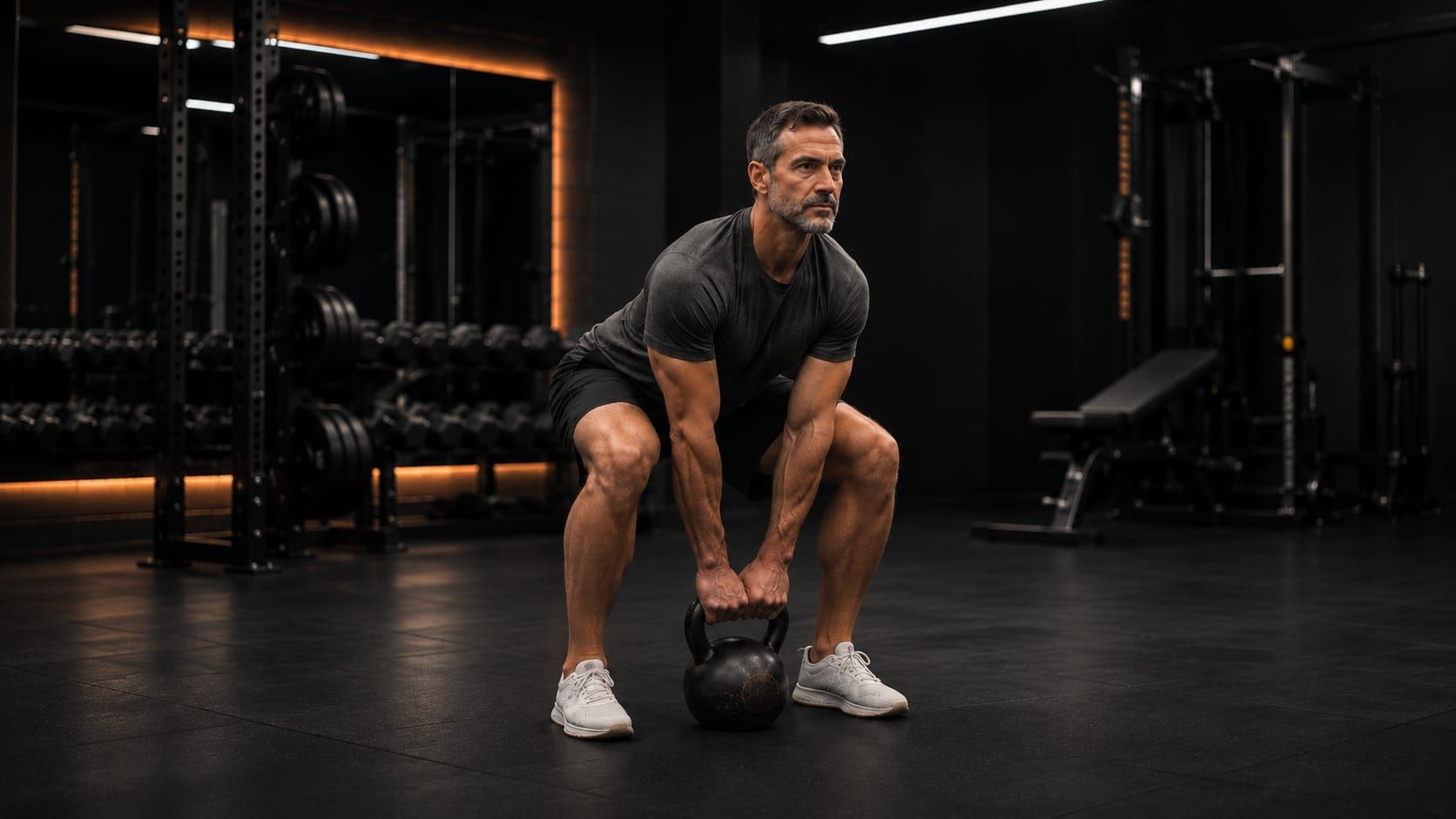
You hit your forties, your back starts playing up, and somewhere along the way someone tells you: “That’s just what happens as you get older.” Maybe a GP said it. Maybe a physio implied it. Maybe you told yourself. It sounds reasonable. It is not.
Age and back pain are correlated. They are not the same thing.
Age Is a Risk Factor, Not a Cause
Yes, the older you are, the more likely you are to have degenerative changes in your spine. Discs lose some hydration over time. Facet joints accumulate wear. These are real, measurable things. But here is what the research and my own experience working with clients consistently shows: those structural changes do not reliably predict who is in pain and who is not.
Plenty of people in their fifties have significant disc degeneration on an MRI and no pain whatsoever. Plenty of people in their thirties have relatively clean scans and are in agony. The scan tells you what the spine looks like. It does not tell you how the nervous system is interpreting that information.
So when someone says “it’s just your age,” what they are really saying is “I don’t know why you’re in pain.” That is an honest position. Dressing it up as an inevitability of getting older is not.
What Actually Determines Whether You’re in Pain
Whether you experience chronic back pain is determined far more by your biology than your chronology. In other words, how well you have taken care of yourself across your lifespan matters a great deal more than the date on your birth certificate.
That is not a platitude. It is a description of how the nervous system works.
Pain is not simply a mechanical output, a signal that fires whenever a structure is damaged. It is a protective response generated by the nervous system when it perceives threat. And the nervous system’s sensitivity, its threshold for sounding the alarm, is shaped by everything happening in your life: not just what is going on in your lower back.
The factors that modulate that threshold are the same factors most practitioners never ask about.
The Levers That Actually Matter
Here is what I look at when I am trying to understand why someone is in pain:
Physical activity. The type and amount of movement you get matters enormously. Not just “exercise” in the abstract, but whether your body is being loaded in ways that build capacity, or whether you are either sedentary or pushing through pain without understanding what you are doing to your nervous system in the process.
Nutrition and hydration. Chronic inflammation, poor tissue quality, low energy availability; these are not separate from your back pain. They are part of the picture. What you eat and drink affects how your body manages and recovers from physical stress.
Stress. This one gets dismissed constantly, and it should not. Psychological stress directly sensitises the nervous system. A client who is under enormous pressure at work, sleeping poorly and running on adrenaline is going to have a much lower pain threshold than the same person on holiday. That is not weakness. That is physiology.
Sleep quality. Poor sleep raises pain sensitivity. It is one of the most consistent findings in pain science, and it is also one of the most ignored in clinical practice. If you are sleeping badly, your back pain will be harder to shift, full stop.
Mindset. How you think about your pain changes how you experience it. Catastrophising, hypervigilance, constantly scanning your body for the next twinge; these are not character flaws, they are learned responses that amplify the nervous system’s alarm signal. One client I worked with described spending years avoiding squash, avoiding playing with her children, avoiding anything that might trigger a flare. The avoidance itself was making things worse. Changing that pattern was, in her words, the biggest win of the whole programme.
Sense of purpose and community. These sound soft. They are not. Isolation and meaninglessness are genuine stressors on the nervous system. People who feel connected and purposeful tend to have better pain outcomes. That is not motivational content; it is a clinical observation.
Why “It’s Just Ageing” Is Such a Damaging Belief
When you accept that your pain is an inevitable consequence of getting older, you stop looking for the actual causes. And when you stop looking, you stop finding solutions.
I have worked with clients who had been in pain for over two decades before we worked together. Decades. They had tried various therapists, done the swimming and the yoga and the Pilates, been told there was nothing more to be done. The belief that age was the culprit had become a ceiling on what they thought was possible.
It is not a life sentence. But accepting that framing makes it one.
The other problem with the “ageing” explanation is that it is unfalsifiable. If your back gets worse, that confirms it. If it gets better temporarily, that is just a good day. It gives you no information and no direction. It is, in the most practical sense, useless.
What to Do Instead
Stop asking “why is my back getting worse as I get older?” and start asking “which areas of my life are falling short, and what can I do about them?”
That is a harder question. It requires honesty. But it is also the only question that leads anywhere useful.
Look at your movement. Are you actually loading your body in a progressive, structured way, or are you either avoiding everything or doing the same thing you have always done and wondering why nothing changes?
Look at your sleep. Not just the hours, but the quality. Are you winding down properly? Is your nervous system actually switching into recovery mode?
Look at your stress. Not to eliminate it (that is not realistic for most of the people I work with, who are running businesses or leading teams or raising young families, often all three at once), but to manage it. To understand how it is affecting your pain and to build in genuine recovery.
Look at your nutrition. Not in a complicated way. Are you eating enough? Are you hydrated? Are you giving your body the raw materials it needs to function?
And look at your mindset. How are you relating to your pain? Are you treating every twinge as a catastrophe? Are you avoiding things that would actually help you because you are afraid of making things worse? These patterns are addressable. They are not fixed features of who you are.
The Nervous System First Approach
This is why I take what I call a nervous system first approach to back pain rehabilitation. Treating chronic back pain as a purely biomechanical problem, fixing the hinge, adjusting the posture, strengthening the core in isolation, misses the point. The nervous system generates pain. If you do not address its sensitivity directly, you are working around the actual problem.
That means the programme I build for each client addresses all of the levers above, not just the ones that show up in a movement assessment. Activity, stress, sleep, nutrition, mindset; these are not optional extras. They are the programme.
It also means the work is genuinely individualised. Two people with the same MRI findings, the same age, the same job title can have completely different pain experiences and need completely different approaches. That is not a complication. That is the reality of how pain works, and it is why generic information, however well-intentioned, rarely produces lasting change.
You Are Not Too Old to Get Out of Pain
If you are in your forties or fifties and you have been in pain for years, you are NOT past the point of recovery. The nervous system is adaptable at any age. The lifestyle factors that are driving your pain are addressable at any age. The physique you want, strong, capable, pain-free, is achievable at any age.
What is required is an honest look at the areas where things have slipped, and a structured, progressive plan to address them. Not a quick fix. Not a magic exercise. A real programme, built around your specific situation, that addresses the root causes rather than managing the symptoms indefinitely.
That is what getting out of chronic back pain once and for all actually looks like.
If you are ready to stop accepting pain as an inevitable part of getting older and want to understand what is actually driving it, book a consultation and we will work it out together. Or if you want to read more about how I approach this, the EVOLVE programme page sets out the detail.
Your age is not the problem. Let’s find out what is.