
From the coaching room
10 Lessons From a 16-Week Physique Transformation Journey

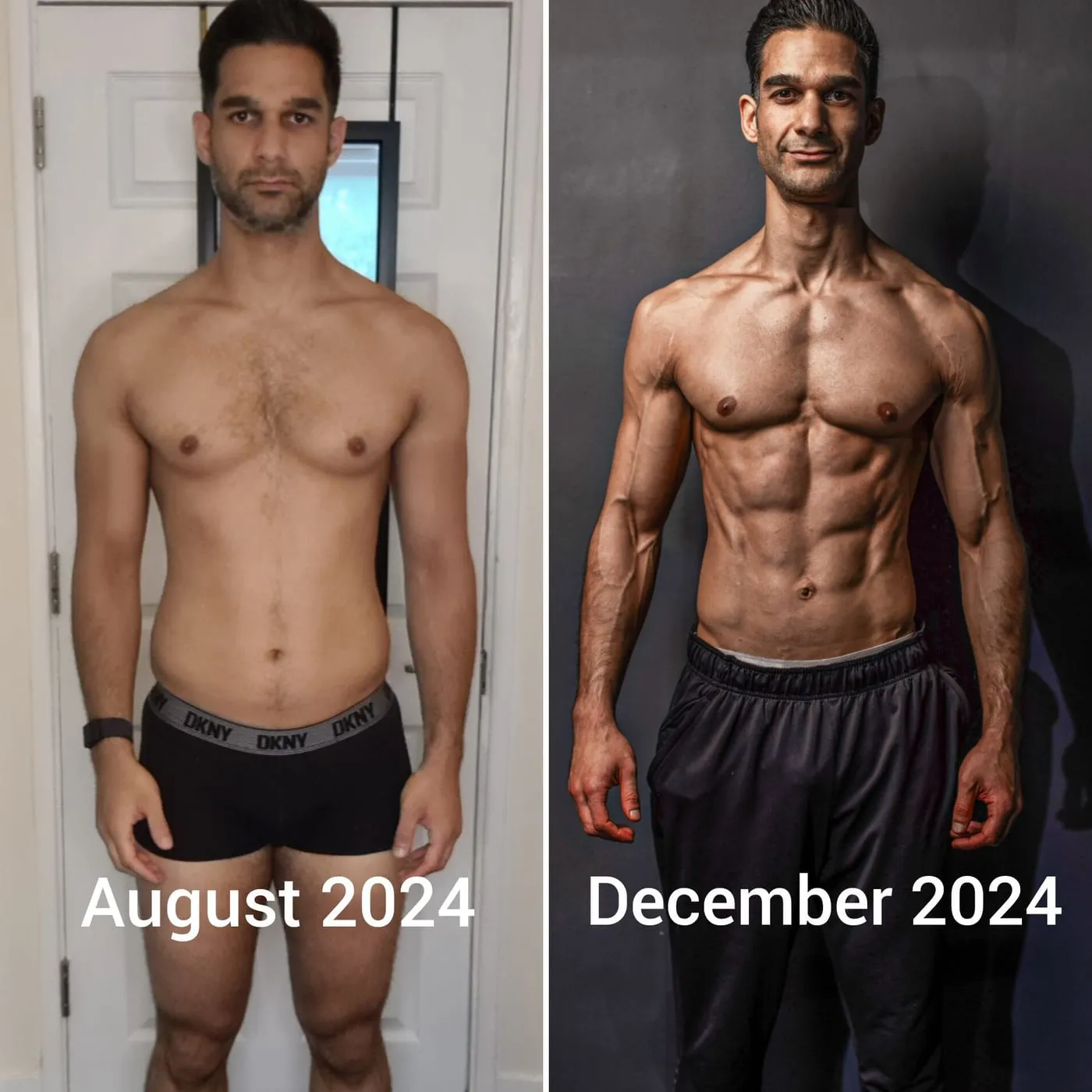
Sixteen weeks is long enough to change your body in ways that are genuinely visible. It is also long enough to learn things about yourself that you did not expect to learn. I went through a physique transformation of my own and what follows are the lessons it confirmed, the ones it uncovered, and the one bonus insight worth its weight in gold.
Some of these will feel obvious. Read them anyway, because there is a difference between knowing something and having it proved to you through sixteen weeks of doing the work.
1. Discipline Is Not a Cage. It Is the Opposite.
The cognitive load and overthinking goes away when you know clearly what is important to pay attention to and what is not. You stop negotiating with yourself each day about every action you need to take in service of your goal. The decision has already firmly been made. You just execute.
That is the freedom in discipline that people who have never experienced it find hard to believe. Discipline is not restriction. It is the relief of not having to think about it anymore.
The corollary to this is equally important: do not try to eliminate distractions first. Most people approach a goal by trying to clear the decks before they start. They wait for the right moment, the quieter month, the less stressful quarter. That moment does not arrive. What actually happens is that when you commit to the actions your goal requires, the distractions lose their grip. You do not remove them; they just stop mattering as much. Focus on the process and the noise burns away on its own.
2. Process Over Outcome, Every Time
This one sounds like a cliché until you feel what it is like to be genuinely absorbed in the process rather than anxiously checking the scoreboard.
When you are fixated on the outcome, every week that does not deliver the result you wanted feels like failure. When you are focused on the process, every week is just another week of doing the work. The outcome is downstream of the process. Dial in the process and the outcome will take care of itself.
What this looks like in practice: you stop asking “am I there yet?” and start asking “did I do what I was supposed to do today?” That is a question you can actually answer. And answering it consistently, week after week, is what produces the result.
3. The Result Is Bigger Than You Think It Will Be
Here is something I did not fully anticipate. The result you achieve will be far greater and further reaching than the eye can see.
Yes, the physical changes are real and they matter. But a sixteen-week transformation also changes how you carry yourself, how you talk about yourself, what you believe you are capable of. It changes your relationship with difficulty. It changes what you think counts as a good reason to stop.
Those changes do not stay in the gym. They travel with you into every other area of your life. That is not a motivational slogan; it is just what happens when you do something genuinely hard and come out the other side of it.
4. You Can Do Harder Things Than You Think
This is the one I want to say plainly, without dressing it up.
You have no idea the depths of your capabilities until you just do the thing. Not think about doing the thing. Not research the thing. Do it.
Most people are operating well within their actual capacity because they have never tested where that capacity ends. Sixteen weeks of structured, progressive training will test it. And what you find, almost without exception, is that the limit was further away than you thought.
The excuses you have dressed up as reasons are not real. That is not a criticism; it is just an observation. Challenge what is possible for you and you will find the challenge was smaller than the story you were telling yourself about it.
5. Commitment Changes the Size of Obstacles
When you flip that mental switch and genuinely commit to a decision, something shifts in how you perceive what is in the way.
Before commitment, every obstacle looks like a reason to reconsider. After commitment, the same obstacle looks like a problem to solve. The obstacle has not changed. Your relationship to it has.
This is not wishful thinking. It is a practical observation about how decision-making works. When the decision is still open, your brain keeps evaluating it. When the decision is closed, your brain starts working on execution instead. Whatever challenges come your way, you have already made certain that you will overcome them. That certainty is not arrogance; it is the natural result of having committed fully.
6. Your Actions Affect More People Than You Realise
Stay on your authentic path. Your actions will inspire others, and even yourself, even when you do not realise it.
This sounds abstract until you notice it happening. Someone in your life starts asking questions about what you are doing. A colleague mentions they have started training again. Your children notice that you take your health seriously. None of this is the reason to pursue your goal, but it is a real consequence of pursuing it honestly.
An honest goal, by the way, is one you would pursue even when no one is watching. Any other kind of goal is a waste of your time, because the moment the external validation dries up, so does the motivation. The goal has to mean something to you specifically, not to the version of you that wants to look good in front of other people.
7. You Do Not Need to Know the Route Before You Start
I will quote Jordan Peterson here, because he said it better than I can: “The path reveals itself when the aim is firmly in mind.”
You do not have to know how to get to where you want to get to. You have to make the decision to get there. The route unfolds as you go. This is not a licence to be vague about your goal; it is the opposite. The aim has to be firm. The method can be flexible.
In practice, this means you do not need to have everything figured out before you begin. You need a clear goal, a structured programme, and the willingness to adapt as you learn. The rest reveals itself.
8. Everything You Need Is Already in You
This one is worth sitting with.
Everything you need to achieve your goal is not outside of you. It is within you already. The capacity for discipline, for consistency, for tolerating discomfort, for showing up when you do not feel like it: all of it is already there. The work is not acquiring those qualities. The work is getting out of your own way and letting what is already inside you come through.
Henry David Thoreau put it this way: “I know of no more encouraging fact than the unquestionable ability of man to elevate his life by a conscious endeavour.” That is not a motivational poster. It is a description of something real. Conscious endeavour, applied consistently, produces results that feel disproportionate to the effort. Not because the effort was small, but because the capacity was always there waiting to be used.
9. Confidence Is Something You Build, Not Something You Have
This might be the most practically useful lesson of the sixteen weeks.
Confidence does not arrive before the work. It arrives as a result of the work. You do not just “have” confidence; you attain it by realising your potential through doing worthwhile things. Every session completed, every week of the programme executed, every small commitment honoured: these are the building blocks of genuine confidence.
The version of confidence that comes from doing the work is also more durable than the kind that comes from external validation. It is grounded in evidence. You know what you did. You know what it cost you. And you know what it produced.
There is no greater fulfilment than living up to your own standards. Not someone else’s idea of what you should be doing, not what looks good from the outside. Your own standards, pursued honestly, over time.
10. Find One Thing That Is Important to You and You’ll Find Everything Else That Is Important to You
This is the last lesson and in some ways the simplest.
For me, the transformation was the one thing. And in pursuing it seriously, I found clarity about sleep, about nutrition, about how I wanted to spend my time, about what I am willing to prioritise and what I am not. One honest commitment has a way of shining a light on everything else in your life to show whether it is truly important to how you live well or not.
The Bonus Lesson: Get a Coach
I said 10 lessons and then added an eleventh because this one is too important to leave out.
Having a coach, someone to hold you accountable and to guide you especially when you have doubts, is indispensable. Spare no expense to invest in one. It will save you time, doubt, frustration, and the particular misery of wallowing in avoidable failures. And you will achieve to a degree you did not think possible, because the coach can see what you cannot see about yourself.
This is not self-serving advice. It is the honest conclusion of sixteen weeks of doing the work. I had a coach for myself (I still do). The accountability matters. The guidance matters. The outside perspective, especially when your own perspective is clouded by doubt or fatigue, matters enormously.
If you are thinking about a physique transformation programme and want to understand what working together would actually involve, the best starting point is a conversation. Book an initial consultation and we can look at where you are, where you want to get to, and what the route between the two looks like.